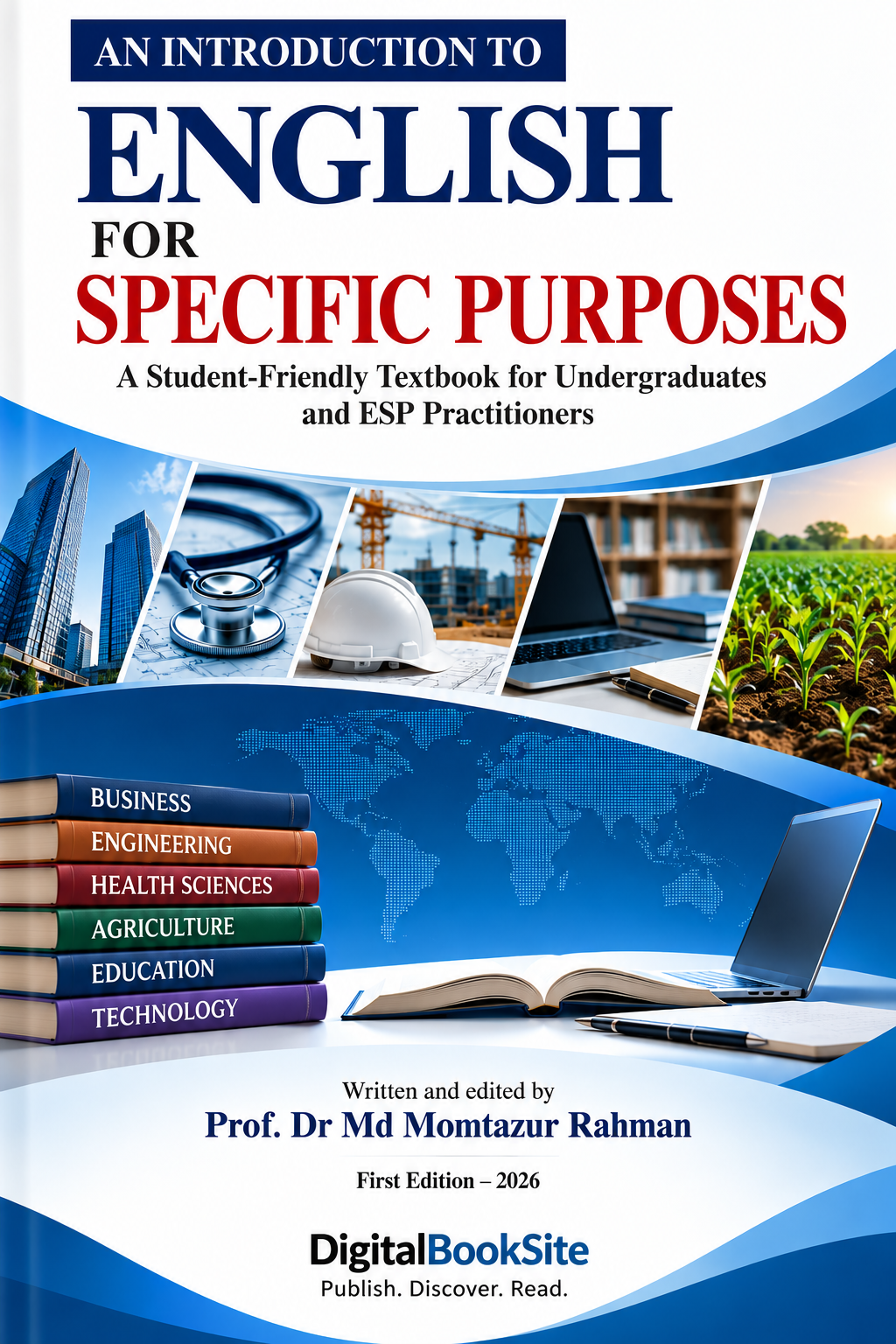
AN INTRODUCTION TO ENGLISH FOR SPECIFIC PURPOSES
A Student-Friendly Textbook for Undergraduates and ESP Practitioners
The book draws on Dudley-Evans and St John’s approach to ESP, which emphasizes that ESP is not simply the teaching of technical vocabulary or selected grammatical structures. Rather, it involves understanding learners’ specific needs and identifying the language, skills, discourse, genres, and disciplinary practices required for effective communication in particular academic and professional contexts. This perspective also highlights the flexibility of ESP, which can be adapted to learners from different disciplines, with varying levels of English proficiency and in diverse learning environments.
Written in accessible language, this book does not assume that readers have prior knowledge of applied linguistics. It introduces essential concepts, explains relevant theoretical perspectives, and illustrates them with practical examples. The chapters guide students through the major areas of ESP, including needs analysis, course design, learning outcomes, materials development, teaching approaches, and evaluation. They also encourage readers to analyze language use, reflect on teaching practices, and apply theoretical knowledge to real-world situations.
Each chapter includes learning outcomes, key terms, explanations, practical examples, activities, and review questions to support learning and self-assessment. The book also provides guidance and practical tools to help students and practitioners conduct basic needs analyses and develop introductory ESP courses.
I hope this concise textbook will serve as a useful resource for undergraduate students of English and other disciplines, as well as for teachers and practitioners who wish to understand and apply the principles of ESP. My aim is to make ESP more accessible to its readers and to encourage the development of English language courses that respond meaningfully to learners’ academic and professional needs.
$ 5.00 USD